


The Story Everyone in Toronto Real Estate Is Talking About
CTV News published a report on April 4, 2026 that’s been shared across Reddit, Twitter, and real estate circles with rare intensity: “Plummeting condo prices leave buyers with massive financial losses.” The r/TorontoRealEstate post linking the story pulled 357 upvotes and 243 comments, making it one of the most-discussed real estate stories on that forum this week.
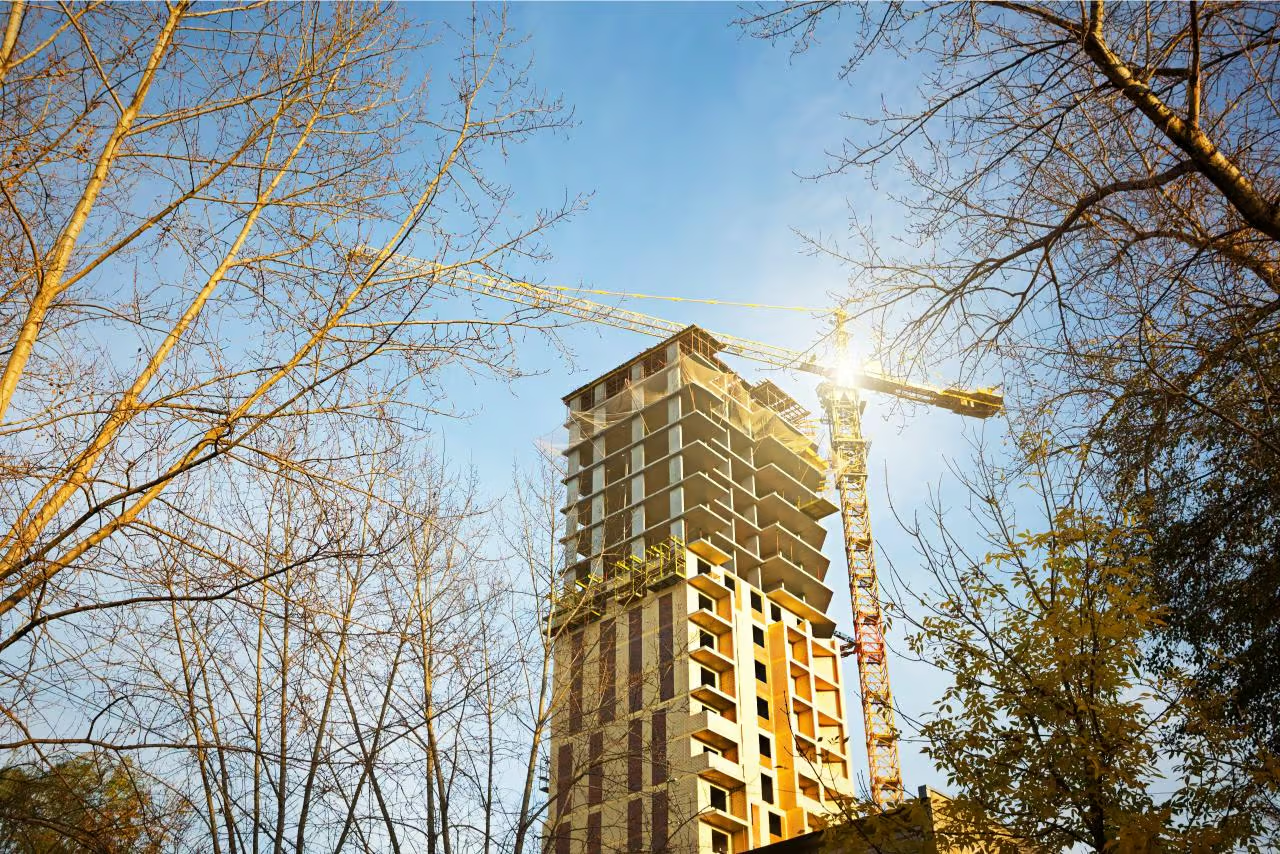
The report covers the painful reality facing thousands of Toronto buyers who purchased pre-construction condos at peak prices in 2021 and 2022, and are now taking occupancy on units worth significantly less than what they agreed to pay.
Looking to buy a condo? Call (416-884-8027) or email (team@amblerhomes.com) to reach us.
How Pre-Construction Works — and Why It Went Wrong
When you buy a pre-construction condo in Toronto, you sign an agreement of purchase and sale based on the developer’s pricing at that time. You pay deposits over the construction period (typically 3–5 years), then the full balance comes due when the building is registered and you take title.
In 2021–2022, Toronto condo prices were at all-time highs. Buyers who signed at those peak prices expected (reasonably, at the time) that values would continue climbing. Instead, what happened was:
- Interest rates surged from near-zero to 5%+ between 2022 and 2023
- Condo prices in the GTA fell sharply, condos are now averaging ~$620,000 and are down approximately 9% year-over-year per the latest TRREB data
- The rental market, which many buyers were counting on for cash flow, also softened significantly
- Many buyers now owe more on their closing than the unit is currently worth on the open market
This isn’t a fringe problem. Market analysts describe it as a consequence of “an unprecedented wave of project completions” arriving at exactly the wrong time – when rates were high, sentiment was negative, and investors were exiting the market.
A report from National Law Review in April 2026 characterized the situation plainly: “A combination of elevated interest rates, an unprecedented wave of project completions, and a mass exodus of speculative investors has pushed condo prices and rents in the Greater Toronto Area to their lowest levels in several years.”
The Numbers Behind the Pain
The Toronto Star’s April 7 analysis of the TRREB March 2026 data put numbers to the decline:
- Condos: down 9% year-over-year
- Semi-detached: down 9.5% year-over-year (steepest of any category)
- Detached and townhomes: both down year-over-year
- Average GTA home price: $1,017,796 — down 6.7% from March 2025
Bloomberg summarized it starkly: “Toronto home prices slip back to 2020 levels as turmoil lingers.” Five years of appreciation, gone.
For a buyer who signed a pre-construction contract in 2021 on a unit priced at $850,000 and is now taking occupancy on a unit worth $700,000–$720,000, that’s a paper loss of $130,000–$150,000 before closing costs, occupancy fees, and land transfer taxes. In some cases, buyers are walking away from deposits rather than close, forfeiting $60,000–$100,000 in deposits but avoiding an even larger loss.
What Options Do Affected Buyers Have?
- Close and hold. If your finances can support the carrying costs, many market analysts expect the Toronto condo market to begin stabilizing through 2026, with gradual recovery in 2027 as the wave of completions subsides. This is a long game, and it requires patience and financial resilience.
- Assign the contract before closing. Some buyers can sell their agreement of purchase and sale to another buyer before registration – an “assignment sale.” This requires developer consent and has tax implications. In today’s market, finding an assignment buyer at breakeven is challenging, but not impossible for well-located projects.
- Negotiate with the developer. Some developers are willing to adjust pricing, offer credits, or restructure deals rather than take back units through failed closings. It’s worth having a lawyer approach the developer, especially if the project has significant unsold inventory.
- Consult a real estate lawyer immediately. Every situation is different. There are clauses in some contracts that may allow rescission under certain circumstances, and there are consumer protection provisions in the Ontario New Home Warranties Plan Act (Tarion) that provide some recourse.
What Current and Future Buyers Should Take Away
This wave of losses is a lesson in pre-construction risk that the market has largely ignored for two decades of rising prices. A few principles that should guide any pre-construction purchase:
Buy for your own use, not speculation. If you’re buying a condo you’d genuinely be happy to live in (or rent at market rates), you’re insulated from the emotional pressure to sell at the worst time.
Stress-test the closing. Before you sign, know exactly what your carrying costs will look like at interest rates 2% higher than today. Can you close if market conditions deteriorate? Can you service the debt?
Understand the occupancy fee period. The period between when you move in and when the building registers (and you take title) can last 1-2 years, during which you pay occupancy fees to the developer rather than paying down a mortgage. These fees are not recoverable.
Don’t use the same realtor as the builder. The builder’s sales rep works for the developer. Use an independent agent and a real estate lawyer who will review the contract without a conflict of interest.
Is There Opportunity in the Carnage?
Somewhat counterintuitively, yes – for the right buyer. The condo correction has brought prices back to levels that make rental economics work for patient investors who are not over-leveraged. With the Ontario government’s new program to buy stagnating developer inventory and convert it to rentals, and the HST rebate now live for new condo purchases, there’s government support being applied to stabilize the sector.
The National Law Review analysis concluded that “most market analysts expect the Toronto condo market to begin stabilizing through 2026, with a gradual recovery in prices and absorption as the completion wave subsides and demand, particularly from renters and first-time buyers, reasserts itself.”
The question is: are we at the stabilization point, or is there more pain ahead? Given global uncertainty, trade tensions, and cautious consumer sentiment, this is a genuine open question. The buyers most likely to succeed are those entering with clear eyes, strong finances, and a multi-year time horizon.
Navigating the condo market in 2026 requires expertise, not guesswork.
Whether you’re a buyer looking for opportunity or a pre-construction buyer trying to figure out your options, The Ambler Team is here to help with straight talk and deep market knowledge. Visit amblerteam.com or reach out directly for a confidential consultation.
Getting ready to buy or sell? Call (416-884-8027) or email (team@amblerhomes.com) to reach us.

Connect With a Top RE/MAX Realtor ®
Thinking about buying or selling? Get expert advice from our team of top Toronto RE/MAX agents.