Ask ten Torontonians where the Junction Triangle is and you’ll get a few blank looks, a couple of people pointing toward The Junction, and maybe one who says, “Oh, by the Railpath?” That last person is right.
The Junction Triangle is one of the west end’s best-kept secrets, and it’s not the same place as The Junction. Here’s where it is, what the homes are like, and what day-to-day life feels like.
Where Exactly is the Junction Triangle?
The name says it all. The Junction Triangle is a wedge of land surrounded on all three sides by railway lines, just west of Lansdowne Avenue in Toronto’s west end. Roughly speaking, it sits between Bloor Street West to the south, Dupont Street to the north, and the Lansdowne and Dundas West area to the east, with The Junction, Bloordale and Dundas West as its neighbours.
Those rail lines are why the neighbourhood feels so tucked away. For a long time the area didn’t even have an agreed-upon name. In 2010, a residents’ group called Fuzzy Boundaries held a public vote, and “Junction Triangle” won. In the City of Toronto’s own statistics, it falls inside the larger Dovercourt-Wallace Emerson-Junction neighbourhood, so be careful when you read area-wide stats: they cover more than just the Triangle.
A tip for buyers: because the borders are rail corridors, not streets, two homes a few blocks apart can feel very different. Some streets back right onto the tracks, while others are quiet and leafy. Always walk the block, and visit at different times of day, before you write an offer.
Looking for the perfect community? Explore West Toronto’s top neighbourhoods in these guides.
- Toronto’s The Kingsway: Neighbourhood: What to Know
- Is High Park a Good Neighbourhood?
- Who Lives in Bloor West Village?
A Neighbourhood Built by the Railways
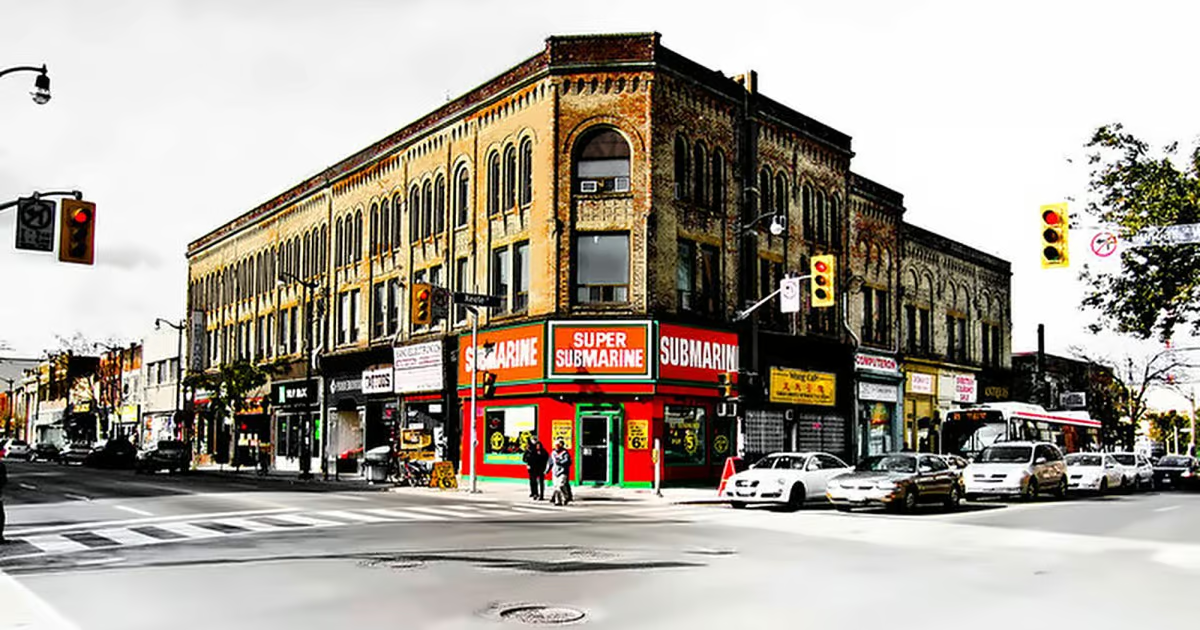
The Junction Triangle grew up as an industrial area. Factories lined the rail corridors for more than a century, and workers’ homes filled the narrow streets between them. The landmark you’ll spot from almost anywhere is the Tower Automotive Building on Sterling Road. When it was built, it was briefly one of the tallest buildings in Toronto.
Today that tower is home to the Museum of Contemporary Art Toronto (MOCA), and it anchors a whole creative district. Former factories nearby now hold Henderson Brewing, climbing gyms, design studios and galleries. Lower Junction, a large mixed-use community, is being built around it on old industrial land.
The Homes
The housing here is a big part of the appeal, and it’s more varied than people expect.
- Victorian and Edwardian semis and row houses. The heart of the neighbourhood is narrow streets of two- and three-storey brick homes, many on modest lots. Lots of them have been renovated, and some have been converted into duplexes or triplexes.
- Detached homes. These are less common and come up for sale less often, but renovated detached homes have been appearing more often in recent years.
- Hard lofts. Real factory conversions with brick walls, timber beams and big windows are this neighbourhood’s signature. They’re hard to find almost anywhere else in the city.
- New condos and rentals. Towers are going up around the edges, including the Galleria on the Park redevelopment at Dufferin and Dupont and a new 18-storey rental building on Perth Avenue that’s expected to be finished in 2028.
On price, the Junction Triangle has long been a bit more affordable than its better-known neighbours like The Junction and Roncesvalles, though it isn’t cheap anymore. In 2026, renovated semis have generally been listed around the $1 million to $1.3 million range, with detached homes higher. Prices change quickly, so ask us for current sold numbers on the specific streets you’re considering.
What to look for: many of these homes are over 100 years old. Budget for a thorough inspection and look closely at the wiring, plumbing, foundation and basement waterproofing. Parking is the other thing to check. Many homes have no driveway, and street permit parking can be tight.
The Lifestyle
The West Toronto Railpath is the backbone. This paved multi-use trail runs along an old rail line through the neighbourhood, and locals use it every day to walk, run, bike to work and walk the dog. Its central section reopened in the summer of 2026 after construction, and an extension heading southeast toward downtown is underway. Once it’s finished, cyclists will have a car-free route most of the way into the core.
Transit is a quiet strength. For a neighbourhood ringed by rail, the Triangle is well connected. You can reach the Bloor GO and UP Express station (one stop to Union, with a direct train to Pearson Airport), plus Lansdowne and Dundas West subway stations on Line 2. Several bus routes run along Dupont, Lansdowne and Bloor.
Food, drink and culture. Sterling Road is the creative core, with MOCA, breweries and cafés. The Dupont strip between Symington Avenue and the Railpath has grown into a small shopping district with galleries, coffee shops and local food spots. And you’re a short walk or bike ride from Bloordale and Dundas West restaurants and the bars in The Junction.
Community spaces. The library branch was recently renamed and expanded as the Junction Triangle branch of the Toronto Public Library. Campbell Park, with its rink, sits just to the east. At Galleria on the Park, a new Wallace Emerson Community Centre with child care, a skating rink and an expanded park is targeted to open in winter 2027.
Need more family-friendly real estate advice? Read these other blog posts next!
- What to Look For in a Family Starter Home
- The Best Private Schools in Toronto: A Guide for Families
- 5 Things to Consider Before Buying a New Build House
Who the Junction Triangle suits
From what we see with our clients, the Triangle is a great fit for:
- First-time buyers who want a freehold house close to downtown and are happy to trade some polish for character.
- Young families who want to bike to school and work, and who’ll make good use of the new community centre and library.
- Creative professionals drawn to lofts, studios and a neighbourhood with an artsy, independent feel.
- Investors looking at legal multiplex conversions close to major transit.
It may not suit buyers who need a two-car driveway or who are sensitive to train noise. Both are worth thinking about honestly before you buy.
A Neighbourhood Still Taking Shape
The Junction Triangle is in the middle of a big transition, with new towers, trail extensions and transit upgrades all arriving at once. That brings construction and change, but it also means today’s buyers are getting in before the neighbourhood is finished. The streets that have kept their old-school character next to all that new investment tend to be the ones people stay on for decades.
Thinking about buying or selling in the Junction Triangle? Reach out to the Ambler Real Estate Team. We’ll walk the streets with you, share recent sales on the blocks you like, and help you work out whether the Triangle is the right fit.
Searching for your perfect home in Toronto? Get in touch with our team! Call 416-884-8027 or email team@amblerhomes.com.


Connect With a Top RE/MAX Realtor ®
Thinking about buying or selling? Get expert advice from our team of top Toronto RE/MAX agents.